



Category: Bioprotection success
In many agricultural regions in Germany, European corn borer infestations are increasing. These pests damage maize by tunnelling into stalks, ears and midribs, weakening plants, reducing yields and creating entry points for fungal pathogens, thereby promoting secondary infections.
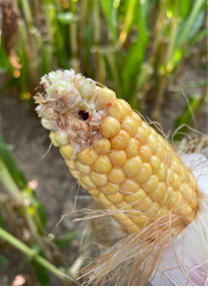
Image: Hole left in the ear of corn caused by European corn borer © BIOCARE
The egg-parasitoid wasp, Trichogramma brassicae is a natural and efficient predator of the corn borer. It lays its eggs directly into the eggs of the corn borer. The developing parasite wasp grows inside the host egg and kills the borer larva before they hatch.
As a widely used biological control agent, Trichogramma helps manage pests without harming beneficial insects such as lacewings and ladybird larvae and avoids the risk of pesticide resistance.
Improving application with drone technology
Traditionally, Trichogramma is applied by hand using cards or capsules, which is labour-intensive and time-consuming. To improve efficiency, drone-based application has been introduced using sensor and AI-supported technology.
Drones enable the capsules containing the wasps to be evenly distributed across fields, regardless of crop height or accessibility. This approach combines effective pest control with faster, more scalable application, making it increasingly attractive for modern agricultural operations.
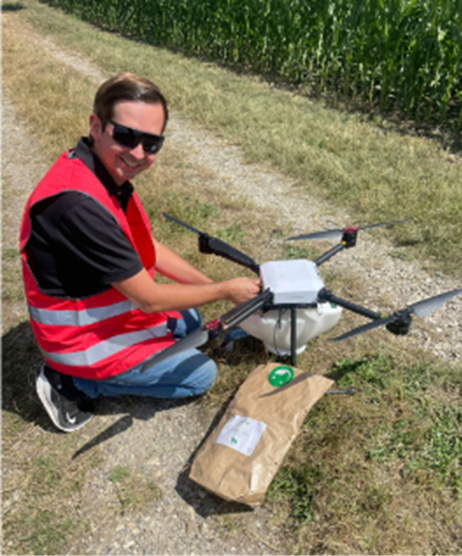
Image: Drone being loaded with Trichogramma capsules © BIOCARE
Impact of insecticide use on Trichogramma efficacy
Trials conducted in southern Germany explored how Trichogramma performs in the field. Biocare analysed the data from 2012-2025 and compared the efficacy of Trichogramma treatments in adjacent plots (see Chart 1). One plot was treated with Trichogramma and the adjacent plot was treated with insecticides. The results showed that Trichogramma efficacy was reduced, and variability increased, when treatments were applied next to insecticide-treated plots.
In many trials, biological and chemical treatments are assessed within the same field. However, Biocare’s findings suggest that this arrangement may underestimate the true effectiveness of Trichogramma, compared with real-world scenarios where it is used independently.
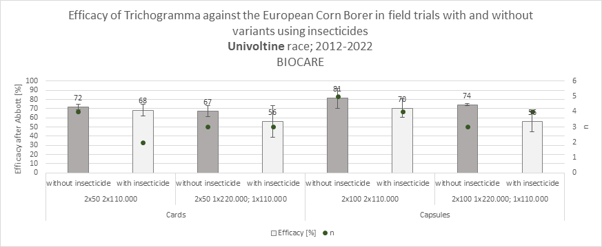
Chart 1: Comparison of Trichogramma efficacy in trials with and without insecticide treated neighbouring plots.
Efficacy without insecticide influence
In a second trial setup, where Trichogramma variants were tested without insecticides, Biocare demonstrated that they provide consistent control of European corn borer, achieving around 73–77% efficacy across different application methods (see Chart 2). While the highest-performing insecticides can reach over 90% efficacy, not all chemical treatments outperform this biocontrol. In fact, Trichogramma delivers similar results to some insecticides, highlighting its competitiveness as a pest management strategy.
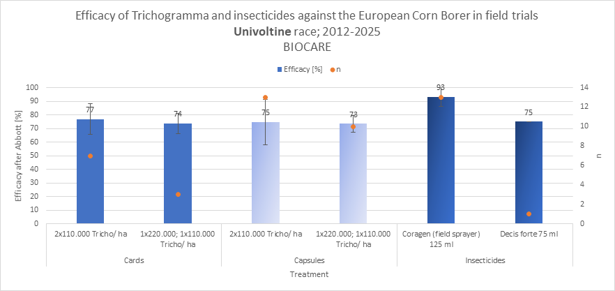
Chart 2: Efficacy of different Trichogramma delivery methods compared to insecticide treatments.
Biocare’s comparison of delivery methods also showed similar results across cards and capsules. However, capsules offer clear practical advantages as they can be distributed by drone, enabling rapid, even coverage across large areas while reducing labour requirements. This makes them particularly well suited to large-scale or hard-to-access fields.
In recent years, the cost of Trichogramma in European countries has been broadly comparable to conventional insecticides. This can vary by country, and in some cases, subsidies are available, making Trichogramma an even more cost-effective option for growers.
In summary
Trichogramma provides a cost-effective and reliable solution for controlling the European corn borer. When combined with drone-based application, it offers a scalable and increasingly sustainable approach to pest management.
By reducing reliance on chemical pesticides and preserving beneficial insect populations, this method helps farmers protect crop yields while supporting more environmentally responsible agricultural practices.
This blog was produced in collaboration with our partner