






Thailand is the leading agricultural exporter in the ASEAN region, and one of the largest globally, with exports in this sector worth more than US$50 billion annually. Driven by global demand for crops such as rice, fruit, rubber and cassava, the sector supports millions of smallholder farmers.
As demand continues to grow, Thailand is placing greater emphasis on sustainable pest management approaches, including biopesticides and Integrated Pest Management (IPM). The aim is to support smallholder farmers in tackling crop pests while reducing the environmental and health risks associated with chemical pesticide use.
The role of biopesticides in Thailand
While many farmers in Thailand still rely on chemical pesticides, biopesticide use is becoming increasingly common. A peer-reviewed study published in Heliyon found that 65% of 300 surveyed smallholder farmers used biopesticides, although 87% continued to rely on chemical pesticides as their primary method of pest control. This highlights growing interest in biopesticides and the need for continued support through training, extension services and improved access to biocontrol products to encourage wider adoption of safer crop protection solutions.
What are biopesticides?
Biopesticides are natural pest control products derived from living organisms such as bacteria and fungi, or extracts from plants or minerals. They are widely used in sustainable agriculture as environmentally friendly alternatives to chemical pesticides.
Why biopesticides are important for sustainable farming
Biopesticides are lower in toxicity and support long-term soil and ecosystem health. They are also compatible with IPM strategies.
IPM in Thailand’s smallholder farming
There is increasing awareness and adoption of IPM in Thailand, particularly among smallholder farmers seeking more sustainable approaches to crop protection. This approach is becoming increasingly important in sustainable agriculture in Thailand, helping farmers reduce chemical inputs, while improving crop resilience and reducing pesticide resistance.
IPM offers many benefits to Thai smallholder farmers including safer working conditions, lower input costs over time, reduced pesticide resistance and protection of key components of farm biodiversity.
What is IPM?
Integrated Pest Management (IPM) is a sustainable and environmentally friendly approach to crop protection. It combines methods such as biopesticides, cultural practices, pest monitoring and targeted interventions to reduce reliance on chemical inputs.
The goal of IPM is to help farmers manage pests while reducing risks to their health and the environment. It encourages healthy crops and minimizes the use of chemical pesticides.
Thailand’s government support for biopesticides
Provincial biocontrol production facilities
Through a biopesticide project funded by the Croda Foundation, CABI is supporting the Thai Department of Agricultural Extension (DOAE) to produce biopesticides in nine biological control production facilities.
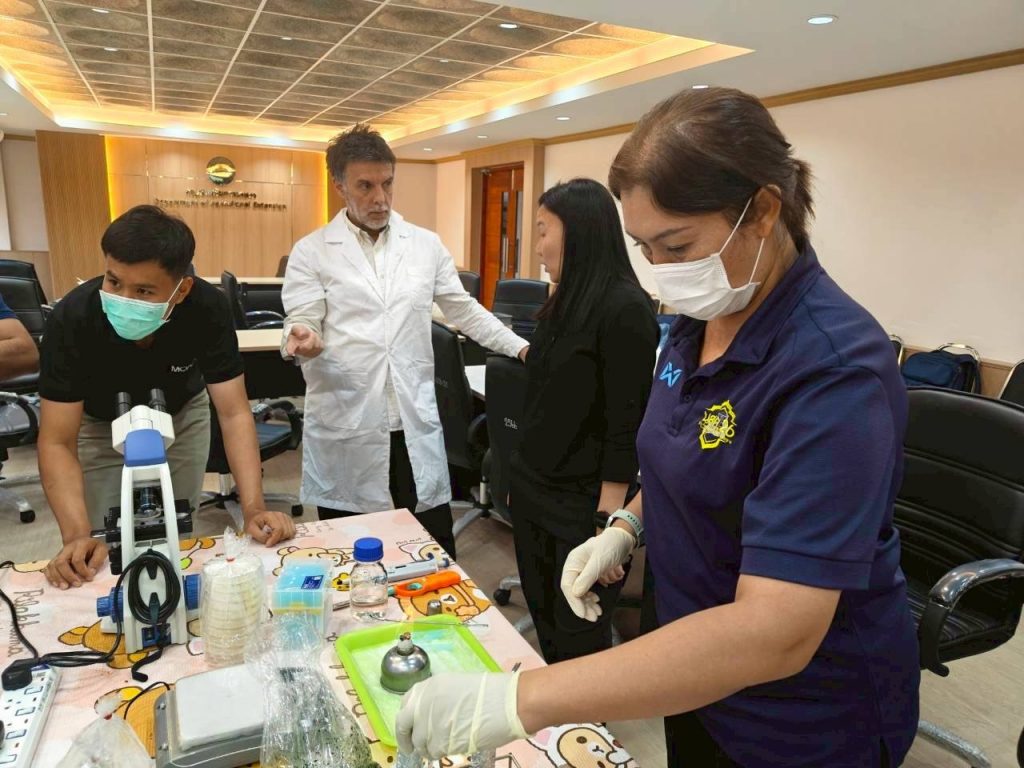
Under this project, CABI is working with the DOAE to strengthen institutional capacity for biopesticide production through structured training for DOAE staff and improvements to the production and formulation of microbial biopesticides. The initiative is expected to support at least 800 farmers and their families by improving access to locally produced biopesticides and promoting safer crop protection, improved health, and more sustainable farming practices.
The DOAE operates the facilities to produce locally adapted biopesticides and other biocontrol products, including predatory insects. These facilities then supply the biological materials directly to farmers or to a network of Crop Protection Management Centres (CPMCs) across Thailand, which then distribute the biopesticides to a wide farming community.
Localised Crop Protection Management Centres
Thailand has established around 3,000 CPMCs nationwide to support smallholder farmers in using safer, more environmentally sustainable crop protection. CPMCs also provide farmers with easier access to biopesticides.
CPMCs act as knowledge and training hubs, providing farmers with guidance on biopesticide use, pest identification, and sustainable pest control practices. These centres play a key role in agricultural extension services in Thailand, supporting smallholder farmers in adopting IPM.

Thailand has also worked with CABI to train farmers on the reduction of pesticide use. Through its PlantwisePlus programme, CABI has delivered 1,040 plant clinics in Thailand to 45,900 farmers who have been provided with a range of IPM options by plant doctors.
Farmers who attended the clinics reported reduced pesticide use, replaced chemicals with safer alternatives, increased use of non-chemical options to tackle crop pests and diseases. Those who stopped applying pesticides reported a dramatic decrease in health problems.
How farmers can access CPMCs in Thailand
Smallholder farmers in Thailand can access CPMCs through their local DOAE offices or village level extension officers. These officers help farmers locate the nearest CPMC, which are widely distributed across rural areas.

At CPMCs, farmers receive support from trained agricultural extension staff and experts who provide:
- advice on pest identification and IPM strategies
- guidance on how to use biopesticides safely and effectively
- access to locally produced biopesticides
- practical training, including pest monitoring and safe application techniques
Through training, technical support and access to locally produced biopesticides, CPMCs are helping farmers manage pests more sustainably and reduce their reliance on chemical pesticides.
The future of biopesticides and IPM in Thailand
Across Thailand, these initiatives are helping farmers transition to safer, more sustainable pest management practices. Biopesticides and IPM are becoming established as practical pest control solutions for smallholder farming in Thailand. With continued support from government initiatives, agricultural extension services, and local biocontrol production, farmers are gradually reducing pesticide use and adopting integrated approaches to crop protection. As these efforts continue, biopesticides in Thailand will play an important role in supporting crop protection, improving crop resilience, and strengthening long-term sustainable agriculture.


