


Summary: Organic farming promotes biodiversity and environmental protection while restricting synthetic pesticides. Biological control is central to organic pest management and involves using natural substances, semiochemicals, microorganisms, and natural enemies to control pests. Combined with cultural practices and other methods, these approaches help farmers protect crops, reduce chemical reliance, and meet organic certification standards.
Overview
What is organic farming?
Cultural practices
Biological control
Summary
FAQ
Organic farming includes a range of farming practices that aim to protect the environment, maintain soil health, support biodiversity, and reduce the use of synthetic fertilisers and pesticides. Different countries have different rules and standards for organic farming. For example, in the United States, organic farming is regulated by the US Department of Agriculture (USDA). In India, requirements for organic certification are defined under the National Programme for Organic Production (NPOP). PGS-India is a government-backed system in which farmer groups certify each other’s organic practices for sale within India, while NPOP governs exports. As a result, methods of organic farming in one country may not be recognised in another.
Worldwide, around 99 million hectares of farmland are managed organically, with approximately 4.8 million organic producers. India alone accounts for nearly half of these producers, with around 2.36 million organic producers in total, including many smallholder farmers.
One of the main requirements of organic farming is to avoid the use of synthetic chemicals, including many pesticides, for pest control. In this way, organic pest control can include biological control methods.
Biological control, sometimes referred to as biocontrol or bioprotection, uses biological products to control pest populations and protect crops. This means biological control methods can be an effective way for farmers to align with organic farming standards. Combined with other forms of pest management, biological pest control can form part of an integrated pest management (IPM) strategy that reduces pest damage while limiting reliance on synthetic pesticides and promoting sustainability.
What is organic farming?
Organic farming refers to agricultural practices that follow specific standards aimed at promoting biodiversity and protecting the environment. The standards cover farmers, the companies that process, handle, or sell organic products, and inputs such as seeds and compost. A significant portion of organic farming certification covers the prohibition of specific chemical substances or pesticides from use on growing land, though there are many other requirements. Different countries have different guidelines.
Under the USDA National Organic Program, organic farming practices include not using banned substances on growing land for at least three years, maintaining soil quality through methods such as crop rotation, and managing pests with physical, mechanical, and biological controls. The Organic Materials Review Institute (OMRI) is a US nonprofit that reviews and lists fertilisers, pest controls, and other inputs that meet organic standards. To obtain and maintain organic certification, farmers must follow specific requirements, which may include preparing an organic system plan and keeping records of their farming activities.
The EU organic regulation lists similar standards to the USDA, and includes protection of natural enemies to control pest numbers, as well as using biological control methods. NPOP emphasises environmental and social responsibility and lists preventive measures, biological pest control, and certain approved pesticides, among other methods, for pest control. As biological control is included in major organic farming standards, it can play an important role in helping farmers obtain and maintain organic certification.
Cultural practices
Organic farming standards generally recommend cultural practices, which involve using specific farming or gardening practices to lower the risk of pest infestations. Examples include:
- Crop rotation: Growing different crops in the same field in a planned order from season to season, so pests that prefer one crop are less likely to build up in the growing area.
- Intercropping: Growing two or more different crops together in the same field to make it harder for pests to find their preferred plant and spread throughout the growing area.
- Trap crops: Planting a crop that pests find more attractive than the main crop, so they gather there instead of on the main crop.
- Resistant varieties: Using plant types that have been bred or selected to tolerate or resist particular pests and diseases. Importantly, genetically modified organisms are generally not permitted on organic farms.
Other habitat management strategies can include planting flowering strips to encourage the growth of natural enemies and predators such as lacewings and predatory mites, which prey on aphids and spider mites, respectively. Organic farming also encourages the use of compost and other permitted organic inputs to improve soil fertility.
Biological control
Biological control methods play an important role in organic farming by helping to manage pests naturally. These methods aim to keep pest populations below the economic threshold, the pest density at which action is needed to stop the population reaching a level that causes financial losses greater than the cost of control. Biological control methods can be divided into four main categories.
Natural substances: These are typically derived from plants, animals and microorganisms and can be used to repel or kill pests. For example, botanical extracts such as neem (azadirachtin) can be used to control pests such as the cotton bollworm (Helicoverpa armigera) and the cotton aphid.
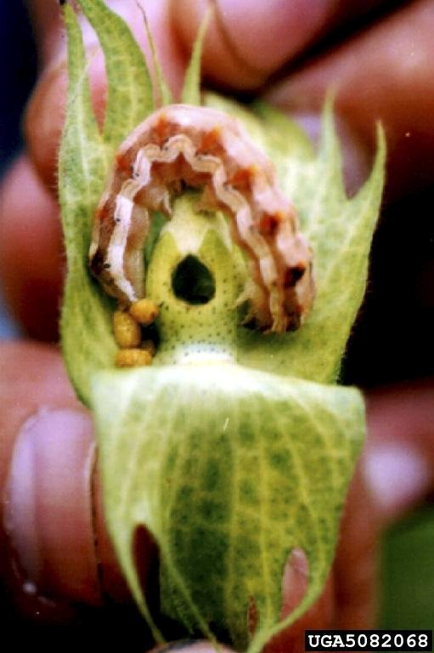
Old world bollworm, cotton bollworm (Helicoverpa armigera (Hübner)) – Credits: O.P. Sharma, Bugwood.org
Semiochemicals: These are messaging compounds, such as pheromones, that can be used to trigger mating disruption in pests and reduce their numbers. Pheromone traps can also be used alongside scouting to monitor pest populations as part of IPM.
Microbials: These are microorganisms like bacteria, fungi, and viruses that harm pests and disease-causing microbes but not crops. For example, nucleopolyhedrovirus (NPV) can be sprayed onto plant foliage, where it is ingested by fall armyworm larvae, killing them and helping to control their numbers.
Beauveria bassiana and Bacillus thuringiensis (Bt) are microbes that can control many pests, including cotton bollworms and European corn borers. Pseudomonas fluorescens is a bacterium that can be used to combat root knot nematodes, while Metarhizium anisopliae is a fungus that can help to control brinjal (eggplant) shoot and fruit borer populations.

White muscadine disease (Beauveria bassiana (Bals.-Criv.) Vuill.) in a
European corn borer (Ostrinia nubilalis (Hübner, 1796)) – Credits: Keith Weller, USDA Agricultural Research Service, Bugwood.org
Macrobials: These are insects, mites and nematodes that are natural enemies, antagonists or competitors of a crop pest. Mealybug ladybirds, also known as mealybug destroyers, prey on certain species of whiteflies and mealybugs. Other examples of macrobials include parasitoids, such as Trichogramma wasps, which lay their eggs inside the eggs of insect pests, and entomopathogenic nematodes, which enter and kill pests such as insect larvae.
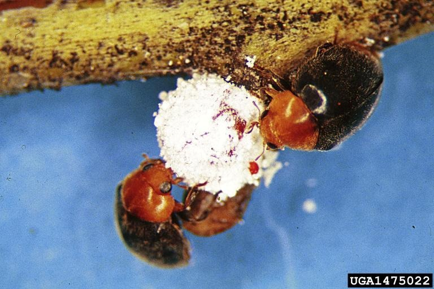
Mealybug destroyer (Cryptolaemus montrouzieri Mulsant, 1853) adults feeding upon a hawthorn mealybug – Credits: Whitney Cranshaw, Colorado State University, Bugwood.org
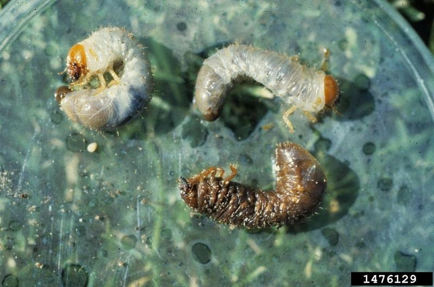
White grub larva killed by entomopathogenic nematode (Heterorhabditis bacteriophora Poinar, 1975) next to two healthy larvae – Credits: Whitney Cranshaw, Colorado State University, Bugwood.org
Summary
Organic farming relies on environmentally responsible practices that protect biodiversity, maintain soil health, and minimise synthetic pesticide use. Biological control supports these goals through approaches including natural substances, semiochemicals, microbials, and macrobials. Alongside cultural practices such as crop rotation, intercropping, and planting resistant crop varieties, these methods provide effective pest management options. Integrating biological control into organic farming strategies helps growers protect crops while meeting certification requirements worldwide.
FAQ
Can certified organic farms use biopesticides?
Yes. Biopesticides can play an important role in pest management on organic farms. Many biopesticides are permitted under organic farming standards set by regulatory bodies, including the USDA in the United States and NPOP in India, although individual products must meet specific requirements.
Is every biocontrol product approved for organic use?
Not necessarily. While many biocontrol products are approved for use in organic farming, it is important to check the requirements of the relevant authorities in each country to ensure that a specific product meets organic certification standards.
What is the difference between organic pest control and biological pest control?
Organic pest control includes methods that comply with organic farming standards, such as preventive measures, cultural practices, and physical, mechanical, and biological controls. Biological pest control specifically uses living organisms or biologically derived substances to manage pests. Biological control can therefore form part of an organic pest management strategy, although not all biological control products are necessarily approved for organic farming.
How can I check if a biocontrol product is allowed under India’s organic standards?
India’s organic standards are outlined by the National Programme for Organic Production (NPOP) and can be viewed on the NPOP website: https://npop.apeda.gov.in/


