





Summary: Eggplants are an important crop worldwide, but their quality and yield are threatened by a variety of pests. Biological controls, monitoring, and cultural practices can help protect eggplants and support healthier yields.
Overview:
What pests affect eggplants?
Fruit and shoot borer
Flea beetle
Lace bug
Whitefly
Aphids
Thrips
Two-spotted spider mite
Colorado potato beetle
How do I manage eggplant pests?
FAQ
Summary
Eggplants (Solanum melongena) are an important crop in many economies, including the United States (US), India, South Asia, and East Africa. In India, the eggplant (known as the brinjal in South Asia or aubergine in the UK) contributes approximately 9 percent of total vegetable production, and across East Asia, it is one of the most important vegetables regarding area under cultivation and total production volume. However, eggplants are vulnerable to pests, which can reduce yields. The fruit and shoot borer alone has been reported in India as causing losses of up to 70%. This article focuses on identifying and controlling common eggplant pests and diseases, exploring the use of biocontrol agents to reduce their impact.
What pests affect eggplants?
Eggplants are vulnerable to threats from a variety of pests, including the fruit and shoot borer, in addition to beetles, thrips, whiteflies, mites, and aphids. Some pests have a greater impact than others, and this can vary with climate and geographic location. For example, the shoot borer is highly destructive in South Asia, but is essentially absent in the US, where flea beetles and the Colorado potato beetle tend to be the dominant threats to eggplant crops.
Fruit and shoot borer (Leucinodes orbonalis)
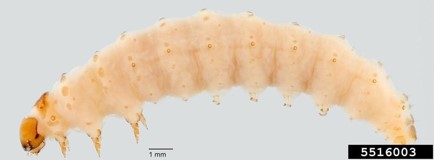
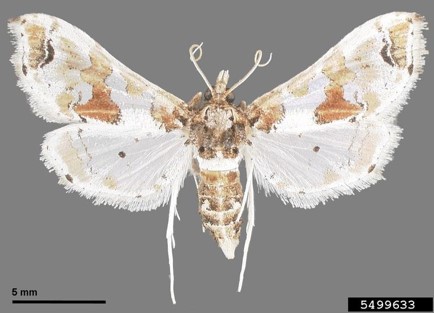
The brinjal fruit and shoot borer damages eggplants in its larval stage by boring into the shoots, flower buds, and fruit, causing shoots to wilt and rendering the fruit discoloured and foul-tasting. The larva is a small caterpillar, appearing pale but with a dark head when newly hatched and becoming pink as it matures, reaching around 18-20 mm in length. The adult moths are small with off-white colouring and scattered pale brown spots. Shoot borer damage may include shoot tips that are wilting, flower and bud drop, and hollow, discoloured fruits containing boreholes (although often appearing normal from the outside).
Tobacco flea beetle (Epitrix hirtipennis)
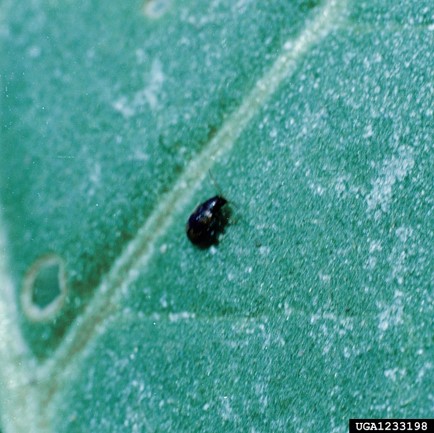
The adult flea beetle causes damage to eggplants by chewing leaves, whereas the larvae feed on the plant roots. The adults are ~1.5 mm long with black, slightly hairy, oval bodies; the larvae are yellowish-white grubs with brown heads that remain in the soil. The main visible symptoms of flea beetles are small holes in leaves, giving a characteristic “shot-hole” appearance.
Eggplant lace bug (Gargaphia solani)
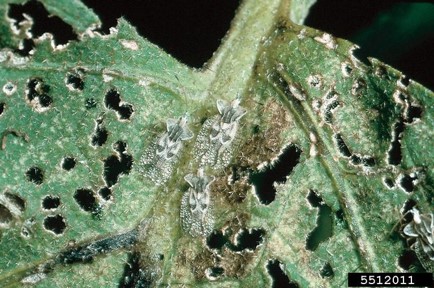
This insect causes damage to eggplants by piercing leaf tissue and sucking out the plant sap. The adult bugs are grey or light brown with pale-yellow legs and two pairs of lace-like wings. They are approximately 5 mm long. The eggs are small and have an elongated oval shape. They are found in circular clusters on the underside of leaves, with each egg deposited on its end and leaning in a different direction. The visible damage caused by lace bugs is roughly circular, discoloured areas on leaves, which eventually become yellow and dry out.
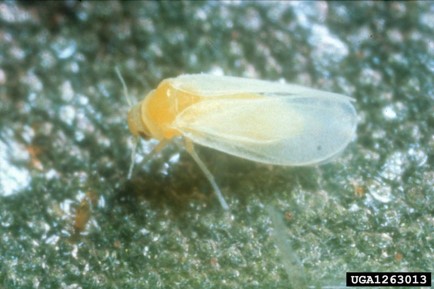
Silverleaf whitefly (Bemisia tabaci)
Both the nymph and adult silverleaf whitefly primarily damage eggplants by feeding on sap from the underside of the leaves. They also cause damage through their waste excretions, which are colonised by mould. Whitefly nymphs are a greenish-yellow elliptical shape, whereas the adults have a greenish-yellow body that is mostly hidden by white wings held in a tent-like position (not flat against the body). Symptoms of adult and nymph feeding on leaves include yellow spotting, vein yellowing, and leaf mottling. Secondary symptoms may also include mould growth, giving the plant a blackened appearance.
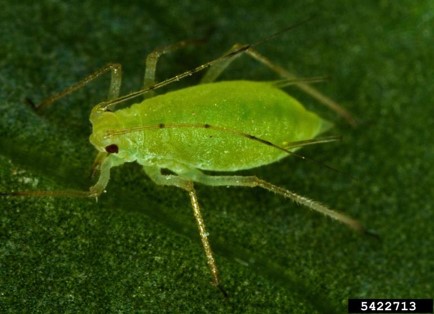
Green peach aphid (Myzus persicae)
This pest damages plants by sucking plant fluids from leaves, injecting toxic saliva, and causing mould issues. The nymphs appear pinkish-red, while the adults are yellowish-green and approximately 1.5-2 mm in length. During an infestation, small yellow spots appear on leaves accompanied by leaf rolling and shape distortion. Secondary symptoms may include sooty mould, which grows on sticky honeydew that aphids secrete.
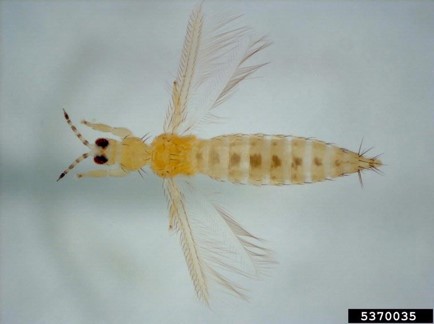
Western flower thrips (Frankliniella occidentalis)
This pest damages the host plant by piercing the surface of leaves and feeding on sap. They are small insects, measuring up to 2 mm in length. They have thin bodies that range in colour from black to straw-coloured, and have two pairs of fringe-hair wings. They cause leaves to turn brown or develop a silvery appearance with yellow patches. They also reduce the number of fruits and can cause discolouration of the fruit’s leafy cap. Thrips can also carry plant diseases.
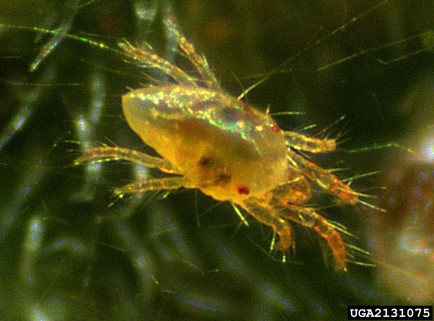
Two-spotted spider mite (Tetranychus urticae)
The two-spotted spider mite feeds on the lower surface of eggplant leaves and causes damage by sucking plant sap from the leaves. They are tiny insects, only growing to about 0.15 mm in length, and are pale-dark green with a black spot on each side of the body (although this is likely only visible under a microscope). Symptoms of this pest include silver or pale-yellow stipples on leaves, which eventually pale and dry up. Large populations may produce visible webbing on the underside of the leaves, as the mites spin webs as they feed.
Colorado potato beetle (Leptinotarsa decemlineata)
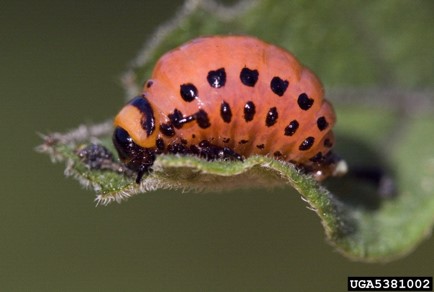
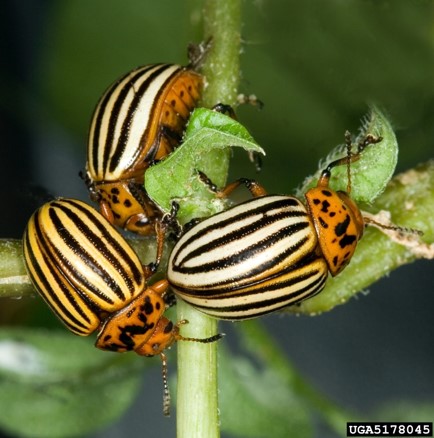
Both the larval and adult stages of this pest feed on leaves and buds. The larvae are orange or a yellowish-red with a black head and black spots. The adult is a yellow-brown colour with a spotty head and stripes down each wing. Symptoms of an infestation include significant defoliation. The pest may consume entire leaves.
How do I manage eggplant pests?
There are multiple methods available for protecting eggplants from pests. A combination of approaches using Integrated Pest Management (IPM) practices and biological control agents works well in many cases, targeting the pests using multiple modes of action.
Monitoring
Farmers should carry out scouting for the symptoms described above. The most common symptoms of damage caused by eggplant pests are leaf discolouration and eggplant fruit yield loss. Some of the species described above, such as the two-spotted spider mite, may be too small to see with the naked eye, but larger pests may be visible on plants, especially if the infestation is large. Some pests cause characteristic damage, such as the shot-hole leaves caused by the flea beetle, and the webbing seen on the underside of the leaf from spider mites.
Cultural control
Cultural control relies on specific non-chemical farming or gardening practices to lower the risk of pest infestations. This method of crop management depends on correctly identifying the pest. Avoiding crop monoculture is a key tactic by rotating eggplant with a crop from a different family to break the lifecycle of the pest. This guidance extends to avoiding plants attacked by similar pests, which in this case includes tomatoes, potatoes, and peppers. Maintaining sanitation and the regular removal of infested crops should be carried out. Fields should be ploughed after harvest to destroy any larvae hiding in the soil. Planting resistant varieties can also help to reduce infestations.
Biological control
- Natural Substances: These are typically derived from plants and can be used in sprays to repel or kill pests. For example, botanical extracts, such as neem oil, can reduce the damage caused by fruit and shoot borers.
- Semiochemicals: These are messaging compounds that can be used to disrupt pest behaviour. For example, methyleugenol is a pheromone attractant for male fruit flies and can be used in traps to prevent eggplant damage.
- Microbials: Microbial pesticides are microorganisms like bacteria, fungi, and viruses that harm pests and disease-causing microbes but not crops. For example, Bacillus thuringiensis is a bacterial species that affects specific insect larvae, such as the fruit and shoot borer larvae, by poisoning and paralysing the digestive system.
- Macrobials: These are larger animals, like certain beneficial insects, that are natural enemies of pests, feeding on or being parasites to pests. For example, parasitoid wasps called Trichogramma are predators of the fruit and shoot borer, laying their eggs inside the eggs of the shoot borer, killing the pest.
Chemical Pesticides
As a world leader in nature-based pest management knowledge implementation, CABI encourages IPM as the preferred, ecologically-based approach to producing healthy crops, which allows for chemical pesticide use only as needed, and when adhering to measures that limit the exposure of people and the environment to them (see FAO, International Code of Conduct on Pesticide Management).
Before considering the use of chemical pesticides, farmers should explore all available non-chemical solutions to control eggplant pests, including the ones listed above. For tailored pest management advice, visit the CABI BioProtection Portal, where you can enter your location and pest problem to explore customised solutions.
In case chemical pesticides are considered for use, farmers should look to select lower-risk chemical pesticides which, when used as part of an IPM strategy, help manage pest problems while minimising harmful effects on human health and the environment. Agricultural advisory service providers can provide information on lower-risk chemical pesticides that are locally available and are compatible with an IPM strategy. These experts can also advise on the required personal protective equipment.
FAQ
What are the major pests of eggplant (brinjal)?
Eggplants are vulnerable to attack from a variety of pests, which vary by region. Major pests include the fruit and shoot borer, lace bugs, aphids, thrips, whitefly, and different species of beetles.
How do you control the eggplant fruit and shoot borer without chemicals?
Cultural control plays an important role in controlling fruit and shoot borers, as they essentially only eat eggplant. Natural substances, such as neem oil, are thought to reduce the damage caused by fruit and shoot borers. Augmentative biological control can also be used to control brinjal pests without the need for chemicals.
What biological control options are available for eggplant pests?
All different forms of biological control can be used on eggplant pests, including natural substances (such as neem oil), semiochemicals such as methyleugenol for fruit flies, as well as microbials and macrobials.
How can advisors help farmers set up an IPM programme for eggplant?
Experts can advise farmers on the different IPM programmes tailored to eggplants and to the specific conditions in which the farmer is working. Based on this information, advisors can help farmers optimise pest management.
Summary
Eggplants are a vital source of income for many farmers and are one of the most important vegetable crops, particularly in South Asia, but yields are threatened by a wide range of pests. Beetles, fruit and shoot borers, mites, thrips, and aphids can all severely reduce plant health, resulting in impacted yields and fruit quality. Effective management requires the accurate identification of pests and the use of IPM strategies. By monitoring carefully and combining cultural practices, biological controls, such as the use of microbials to kill pests, and controlled pesticide use where needed, growers can protect their eggplants while promoting sustainable and resilient eggplant fruit production.
We have prepared extensive guides on protecting other related crops, including tomato, and controlling fungal diseases, such as botrytis.


