





Category: Bioprotection success
Summary: Under the PlantwisePlus programme, CABI and its national partners demonstrated that a Trichogramma-based biological control approach, combined with biopesticides, can effectively manage major vegetable pests in Bangladesh while significantly reducing reliance on chemical insecticides.
Overview:
- Scaling biological control in Bangladesh
- The challenge: managing brinjal and tomato borers
- The solution: Trichogramma and biopesticides
- Key results
- Higher yields, lower pest damage and reduced costs
- Farmers validate the science
- Triple-bottom-line benefits reported by farmers
- Challenges and opportunities for scaling up
- Conclusion: a promising model for sustainable vegetable production
Brinjal (eggplant) and tomato are important vegetable crops in Bangladesh. However, the brinjal shoot and fruit borer and tomato fruit borers are among the most damaging pests affecting productivity and profitability.
Scaling biological control in Bangladesh
Under the PlantwisePlus programme, CABI is working with national partners to increase the availability and adoption of sustainable pest management solutions, including augmentative biological control solutions. In Bangladesh, CABI works closely with the Bangladesh Agricultural Research Institute (BARI), the Regional Agricultural Research Station (RARS) in Rangpur, the Department of Agricultural Extension and other national stakeholders to demonstrate how locally produced biological control agents can help farmers manage important vegetable pests while reducing reliance on chemical pesticides.
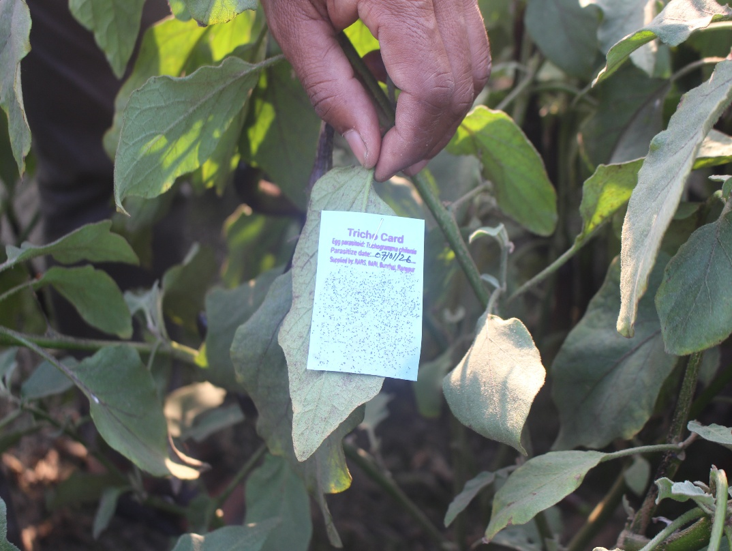
A key component of this work is supporting the establishment and operation of Trichogramma Rearing Facilities (TRFs), that target the eggs of destructive lepidopteran pests before they can damage crops.
In Rangpur, the focus of the TRF is on managing the brinjal (aubergine) shoot and fruit borer and tomato fruit borers, among the most damaging pests affecting productivity and profitability on these two high value crops.
The challenge: managing brinjal and tomato borers
Vegetable farmers in Bangladesh often face severe losses from insect pests that attack shoots, flowers and fruits. To protect their crops, many farmers rely heavily on repeated insecticide applications.
In the project sites, conventional farmers were applying as many as 16 insecticide sprays on brinjal and 10 sprays on tomato during a single season. Despite this intensive pesticide use, pest infestations remained a challenge, while costs, labour requirements and concerns about environmental and human health impacts continued to grow.
CABI and partners therefore evaluated whether a biological-control-based approach could provide comparable or better results while reducing dependence on synthetic pesticides.
The solution: Trichogramma and biopesticides
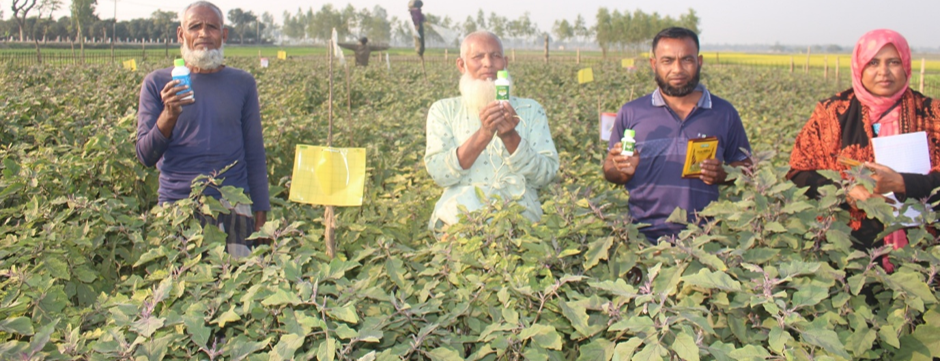
The integrated pest management (IPM) package tested in farmer fields centred on the release of Trichogramma parasitoid wasps from locally produced egg cards supplied by the Rangpur TRF. Five releases were carried out during the 2025 to 2026 growing season. Where pest pressure was observed, Trichogramma releases were complemented with biological pesticides, including:
- Bio-Chamak, a botanical product based on Celastrus angulatus
- Bio-BTK, a microbial product based on Bacillus thuringiensis
- A Spodoptera nuclear polyhedrosis virus (NPV) product in tomato
This approach allowed beneficial insects and natural enemies to play a larger role in pest suppression while reducing the need for chemical insecticides.
Key results
| Impact area | Key finding |
| Pest control | Brinjal shoot and fruit infestation reduced by more than 50% |
| Tomato fruit infestation reduced by more than 80% | |
| Yields | Brinjal yields increased by 17% |
| Tomato yields increased by 32% | |
| Profitability | Brinjal treatment costs reduced by 57% |
| Net income increased by 23% | |
| Insecticide use | Demonstration farmers successfully produced brinjal without using insecticides |
| Environment | Higher populations of beneficial insects observed in biologically managed fields |
Higher yields, lower pest damage and reduced costs
Brinjal
Field trials conducted in Rangpur demonstrated clear improvements from the IPM package, which combined Trichogramma and biopesticides.
Compared with conventional farmer practice:
- Shoot infestation was 1.94% compared to 3.75% in the control group.
- Fruit infestation (by number) was 4.02% compared to 11.61% in the control group.
- Yield increased from 33.5 t/ha to 39.26 t/ha.
Tomato
Results were even more striking in tomato fields near Dinajpur.
Compared with conventional practice:
- Fruit infestation (by number) declined from 8.94% to 1.40%.
- Yield increased from 27.65 t/ha to 36.45 t/ha.
Farmers validate the science
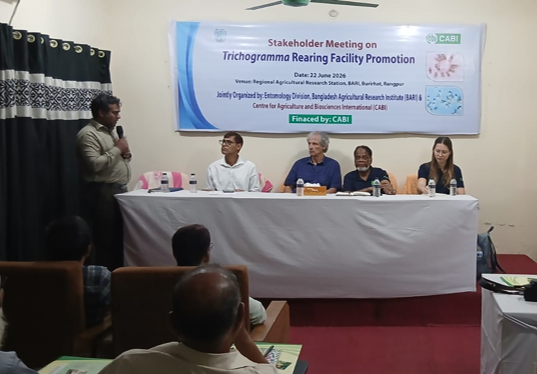
To understand farmers’ experiences with the technology, CABI and BARI organised a workshop with farmers who had participated in the brinjal demonstrations.
The discussion strongly reinforced the field-trial findings. Farmers reported that replacing insecticide sprays with Trichogramma releases and biological pesticides had delivered benefits across the social, economic and environmental dimensions of sustainability.
Triple-bottom-line benefits reported by farmers
The feedback from participating farmers aligned closely with the field-trial results. In addition to reporting economic, social and environmental benefits, farmers highlighted higher yields, lower production costs and reduced reliance on insecticides.
Economic benefits
- All participating farmers reported higher yields than in previous seasons and neighbouring conventionally managed fields.
- Farmers reported lower production costs.
- Most farmers experienced a longer harvesting period, creating additional marketing opportunities.
Economic performance of biological control compared with conventional treatments:
| Treatment | Yield (t/ha) | Gross return (Tk/ha) | Cost of treatment (Tk/ha) |
| Biological treatments | 39.26 | 981,500 | 26,771 |
| Conventional treatments | 33.50 | 837,500 | 61,600 |
Cost and return analysis of brinjal under different management approaches at farmers’ fields in Horipur, Chandanpat, Rangpur during the 2025–26 growing season.
Social benefits
- All farmers reported reduced labour requirements compared with repeated insecticide spraying.
- Farmers reported that pest management was less physically demanding.
Environmental benefits
- Researchers also observed higher populations of natural predators (ladybeetles and spiders per plant).
- Reduced use of synthetic pesticides may provide environmental benefits by supporting beneficial insect populations.
The results suggest that biological control can provide effective pest suppression while supporting natural predator populations and broader ecosystem health.
Farmer confidence and adoption potential
Importantly, farmers stated that the biopesticides used in the programme were affordable and believed other farmers could be persuaded to adopt similar biological approaches. Extension staff seconded the positive statements from farmers.
Challenges and opportunities for scaling up
The success of the trials has highlighted a significant opportunity to expand biological control in Bangladesh’s vegetable sector. However, one major challenge remains getting Trichogramma egg cards to farmers efficiently and affordably.
Transporting egg cards while maintaining product quality creates additional costs and logistical requirements. The Rangpur TRF can produce far more Trichogramma than it currently distributes, but many tomato-growing areas are located some distance from the facility. Stakeholders agreed that sustainable delivery mechanisms and dedicated funding will be essential to support wider adoption.
At the same time, extension services and project partners are strengthening farmer capacity through training on IPM and biological control. Increased awareness, practical demonstrations and farmer-to-farmer learning will help ensure that farmers understand when and how to use Trichogramma and complementary bioprotection products effectively.
With the experience of this field trial and additional training on IPM and biological control, the hope is that farmers will be willing to purchase Trichogramma egg cards for 3 taka per card. They will therefore contribute to the longevity of the TRF and its impact.
Conclusion: a promising model for sustainable vegetable production
The experience in Bangladesh demonstrates that Trichogramma-based biological control, combined with compatible biopesticides, can successfully manage key vegetable pests while reducing dependence on conventional insecticides. Farmers achieved higher yields, lower pest damage, reduced costs and less labour, while benefiting from a more environmentally sustainable production system.
Based on both the field data and farmer feedback, the approach shows strong potential for wider adoption across Bangladesh’s vegetable-growing regions. As production and distribution systems continue to mature, the Rangpur TRF could become an important model for scaling biological control and supporting healthier, more resilient food systems.

